Essay

Tracing Galactic Memory….
The Hidden Relationship between the Sun, Sirius and the Pleiades

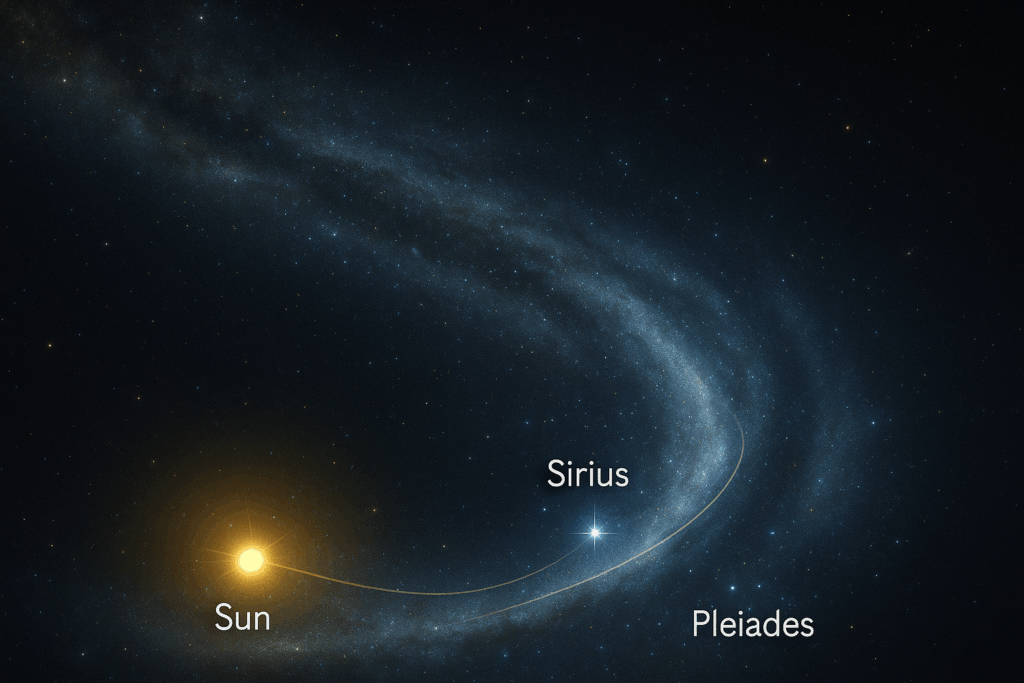
Within the Orion Arm, a hidden harmony connects the Sun, Sirius, and the Pleiades — not by gravity, but through resonance.
Their alignment reveals an ancient frequency field that shaped both cosmic order and human consciousness.

Tracing Galactic Memory….
The Hidden Relationship between the Sun, Sirius and the Pleiades

As a metaphysical astrologer I have long sensed that our star, the Sun, does not stand alone but participates in a wider cosmic field. My initial thought was provocative: perhaps the Sun and Sirius form a kind of “double star system” , not in the sense of shared barycentres or gravitational binding, but in the sense of resonant frequency coupling. As I traced this idea further, I found that the Pleiades cluster must also be part of this scheme, forming a triadic anchor: Sun, Sirius, Pleiades. In this essay I propose that these three celestial bodies occupy the same galactic structure, the Orion Arm, and that this shared location underpins a coherent resonance. I also argue that ancient civilisations recognised this resonance and encoded it in their monuments and calendar systems. Finally, I suggest that our contemporary rediscovery of megalithic sites is connected to a re-awakening of this cosmic frequency.

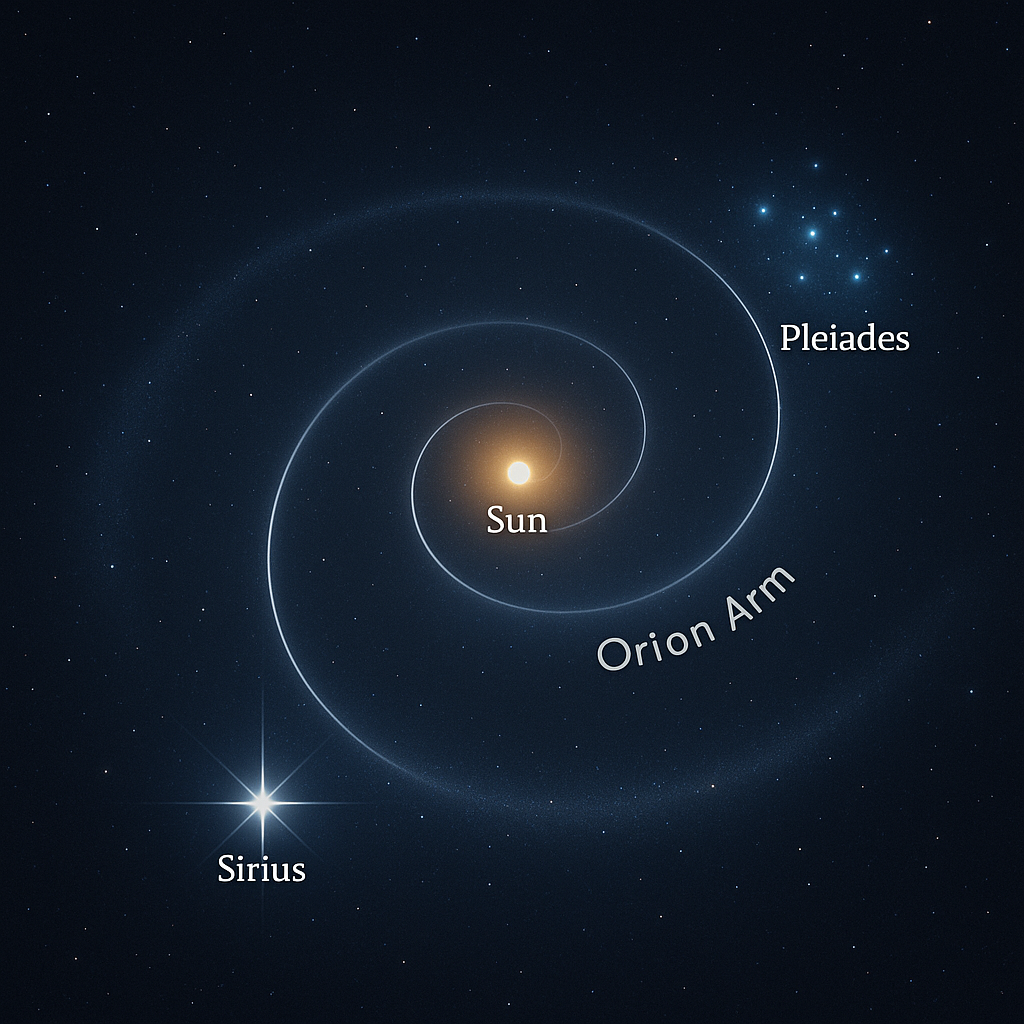
The Milky Way is a barred spiral galaxy, and our Solar System resides in what is commonly called the Local Arm or Orion Arm. According to Xu et al. (2016) the Local Arm was once considered a negligible spur but more recent data reveal that it is substantial in size and star-forming activity. The Radcliffe Wave research (Swiggum et al., 2022) shows that the gas spine of the Orion Arm is dynamic, wavy, and richly structured. These findings matter because being located in the same spiral arm means that stars and clusters share orbital dynamics, pattern speeds of the arm, and exposure to similar magnetised plasma environments. In the formal language of stellar dynamics, moving groups and open clusters within a spiral arm may be influenced and “trapped” by spiral density waves and co-rotation resonances (Barros et al. 2019). Thus, the Sun should not be viewed as an isolated point in space but as a participant in a galactic concert; Sirius and the Pleiades are fellow performers within the same local resonance field.

The Sun is located approximately twenty-six thousand light-years from the galactic centre and propagates within the Orion Arm segment of the Milky Way. Sirius, the bright star in Canis Major at about 8.6 light-years away, is extremely near in galactic terms and shares our local stellar neighbourhood in the Orion Arm. The Pleiades cluster (M45), located roughly 444 light-years away in Taurus, is also situated within the Orion Arm and forms part of the broader cluster ensemble associated with this spiral segment (Famaey et al. 2008). Because all three bodies occupy the same arm, they move within the same galactic “frequency band”: the pattern speed of the spiral arm, the density wave of the arm, the ambient plasma and interstellar medium, and the magnetic field structure. My working hypothesis is that the Sun, Sirius and the Pleiades form a frequency system: the Sun as the planetary focal star, Sirius as a nearby stellar beacon, and the Pleiades as the cluster-memory node inside the same galactic field.

Orion Arm

Across ancient cultures the visible stars in the sky such as Sirius and the Pleiades repeatedly appear in myth, ritual and architecture. In Egypt, the heliacal rising of Sirius (Sopdet) signalled the renewal of the Nile and thus of life. In the Americas, the Pleiades marked the beginning of seasons and agricultural time. These alignments suggest a recognition of stellar rhythm. Considering that the Sun, Sirius and the Pleiades share the same galactic zone, it becomes coherent that these three became anchor points in cosmologies and that megalithic builders aligned their structures accordingly — as if translating a galactic frequency into stone, direction and myth.

Why, then, do we see a surge in the discovery and re-interpretation of megalithic pyramid sites since roughly 2012–2013, when these structures have stood for millennia? I propose that there are overlapping reasons. Technological advancements (such as LIDAR and satellite geophysics) now reveal what was hidden. More deeply however, we are entering a phase of the precession of the equinoxes in which our solar neighbourhood traverses a critical segment of the spiral arm. The ambient plasma environment, magnetosphere and heliosphere respond, and collective consciousness begins realigning with the galactic field. In that window of renewed resonance, ancient monuments (for example Göbekli Tepe, built just after the Younger Dryas) aligned to Sirius, and research into the Bosnian pyramids suggests alignments to the Pleiades and Polaris. These structures can be seen as earthly reflections of the galactic frequency field and its remembrance in stone.

If this framework is correct, several testable lines emerge. One may measure the pattern speed and corotation radius of the Orion Arm (Xu et al. 2016) and compare the orbital velocities of the Sun, Sirius and Pleiades cluster. One can examine plasma or magnetic wave structures in our local interstellar medium (such as the Radcliffe Wave) for evidence of coherent oscillations (Swiggum et al. 2022). One can also carry out archaeoastronomical surveys of ancient sites and test for statistically significant orientations to Sirius, Pleiades or solar-rise at equinox. Studies of moving-group kinematics (Antoja et al. 2008; Barros et al. 2019) may show that clusters such as the Pleiades moving group and the Sirius moving group share a common origin or resonance zone tied to the Local Arm. By constructing such a bridge between astrophysics (stellar dynamics, galactic structure) and metaphysical-astrology (frequency, resonance, consciousness) we open a new paradigm.

Ultimately, the Sun, Sirius and the Pleiades are not random points of light in the sky but nodes in a galactic frequency continuum. They exist within the Orion Arm, share a resonant field, and were remembered by our ancient ancestors through architecture, story and ritual. We stand at a moment when our solar neighbourhood is awakening to its galactic identity once more. The stones of our ancestors, the monuments, the sky-alignments and our own consciousness are tuning back into the same cosmic rhythm. The question thus becomes not merely what stars are out there, but who we truly are in relation to these stars.

Desiree van Toor

Metaphysical Astrologer & researcher


© 2025 Desiree G.E. van Toor. All rights reserved.

References

Bland-Hawthorn, J., & Gerhard, O. (2016). The Galaxy in context: Structural, kinematic, and integrated properties.Annual Review of Astronomy and Astrophysics, 54, 529–596. https://doi.org/10.1146/annurev-astro-081915-023441
(Comprehensive overview of the Milky Way’s structure — foundational for contextualizing the Orion Arm.)

Famaey, B., Siebert, A., & Jorissen, A. (2008). Local kinematics of K and M giants: New evidence for a hexagonal Galactic disk. Astronomy & Astrophysics, 483(2), 453–466. https://doi.org/10.1051/0004-6361:20078776
(Links the Sirius and Pleiades moving groups within the same dynamic zone — supports the resonance model.)

Frisch, P. C., Redfield, S., & Slavin, J. D. (2011). The interstellar medium surrounding the Sun. Annual Review of Astronomy and Astrophysics, 49, 237–279. https://doi.org/10.1146/annurev-astro-081710-102613
(Explains local plasma and magnetic structures influencing both the Sun and Sirius.)

Reid, M. J., Menten, K. M., Brunthaler, A., et al. (2019). Trigonometric parallaxes of high-mass star forming regions: The structure and kinematics of the Milky Way. The Astrophysical Journal, 885(2), 131. https://doi.org/10.3847/1538-4357/ab4a11
(Defines the Milky Way’s arm geometry — confirms the Sun and nearby stars’ placement in the Orion Arm.)

Swiggum, E., Alves, J., Zucker, C., Goodman, A. A., & Meingast, S. (2022). The Radcliffe Wave: A massive, wave-like gas structure in the solar neighborhood. Nature, 601, 334–338. https://doi.org/10.1038/s41586-021-04286-5
(Reveals plasma and magnetic wave patterns within the Orion Arm — supports the concept of frequency-based linkage.)

Xu, Y., Reid, M. J., Zheng, X. W., & Menten, K. M. (2016). The Local Arm of the Milky Way: Structure, kinematics, and star formation. Science Advances, 2(9), e1600878. https://doi.org/10.1126/sciadv.1600878
(Establishes the Orion Arm as a coherent spiral structure containing the Sun, Sirius, and the Pleiades.)